
Categories
Clarksville TN Real Estate, Selling a homePublished August 18, 2026
You PCS'd — Now You're an Accidental Landlord. Here's What to Actually Check.

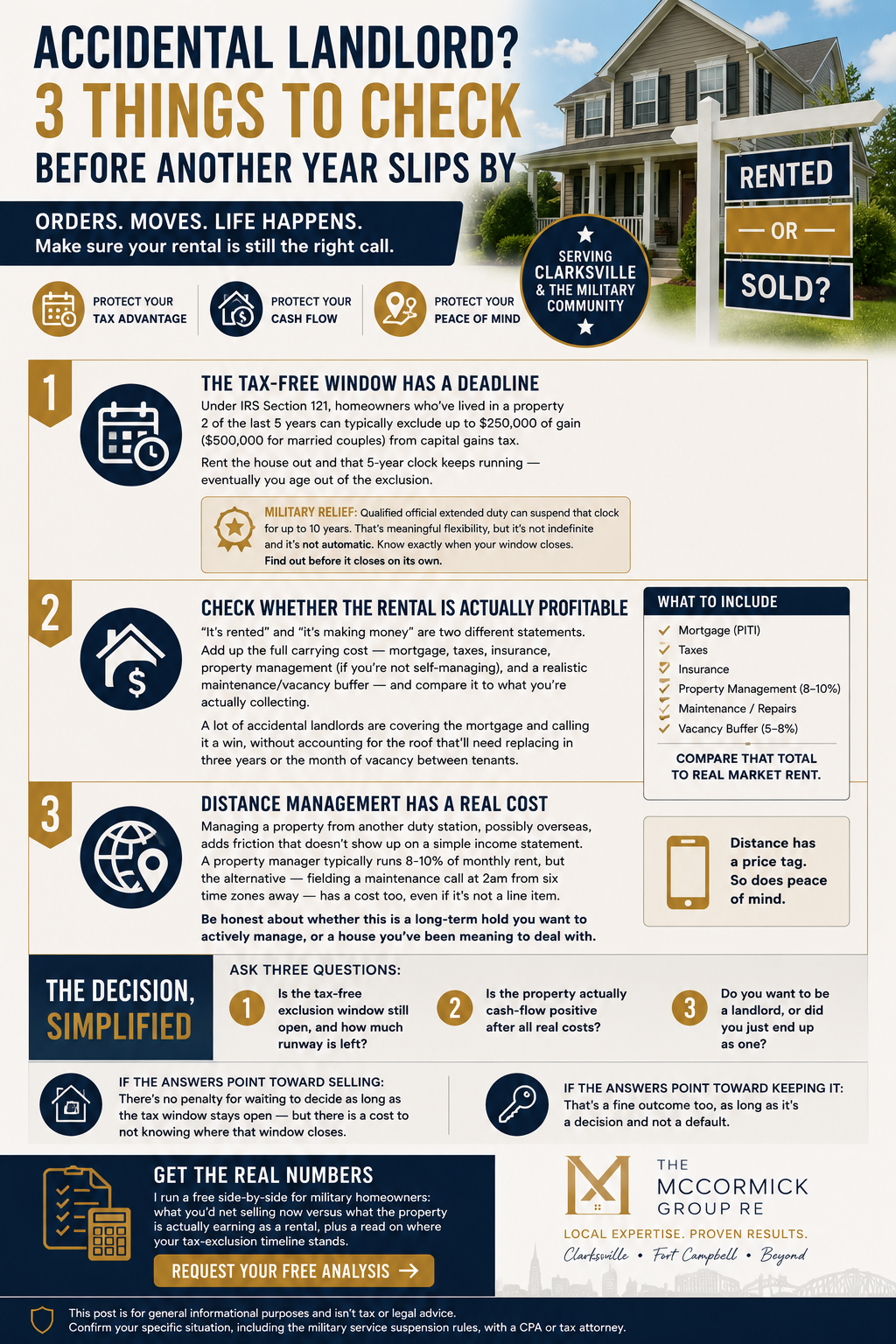
Nobody plans to become a landlord. It just happens — orders come through, the house doesn't sell in time, or renting felt like the easier call in the moment. A year or two later, that decision is still sitting there, mostly unexamined.
If that's you, here are the three things worth actually checking before you let another year pass on autopilot.
1. The tax-free window has a deadline
Under IRS Section 121, homeowners who've lived in a property 2 of the last 5 years can typically sell it and exclude up to $250,000 of gain ($500,000 for married couples) from capital gains tax. Rent the house out and that 5-year clock keeps running — eventually you age out of the exclusion.
Military homeowners get real relief here: qualified official extended duty can suspend that clock for up to 10 years. That's meaningful flexibility, but it's not indefinite, and it's not something that happens automatically. If you don't know exactly when your window closes, that's the first thing to find out — before it closes on its own.
2. Check whether the rental is actually profitable
"It's rented" and "it's making money" are two different statements. Add up the full carrying cost — mortgage, taxes, insurance, property management (if you're not self-managing), and a realistic maintenance/vacancy buffer — and compare it to what you're actually collecting.
A lot of accidental landlords are covering the mortgage and calling it a win, without accounting for the roof that'll need replacing in three years or the month of vacancy between tenants. If you haven't run this math since you PCS'd, it's worth doing now — the answer might surprise you in either direction.
3. Distance management has a real cost
Managing a property from another duty station, possibly overseas, adds friction that doesn't show up on a simple income statement. A property manager typically runs 8-10% of monthly rent, but the alternative — fielding a maintenance call at 2am from six time zones away — has a cost too, even if it's not a line item.
Be honest about whether this is a long-term hold you want to actively manage, or a house you've been meaning to deal with.
The decision, simplified
Ask three questions:
- Is the tax-free exclusion window still open, and how much runway is left?
- Is the property actually cash-flow positive after all real costs?
- Do you want to be a landlord, or did you just end up as one?
If the answers point toward selling, there's no penalty for waiting to decide as long as the tax window stays open — but there is a cost to not knowing where that window closes. If the answers point toward keeping it, that's a fine outcome too, as long as it's a decision and not a default.
Get the real numbers
I run a free side-by-side for military homeowners: what you'd net selling now versus what the property is actually earning as a rental, plus a read on where your tax-exclusion timeline stands.
[Request your free analysis → 615-772-1709]
This post is for general informational purposes and isn't tax or legal advice. Confirm your specific situation, including the military service suspension rules, with a CPA or tax attorney.

Angie McCormick
Broker/Owner | The McCormick Group
or another way